
Tome
verified★★★★★4.6(15,000 reviews)
edit_documentBy AIToolsHaven Editorial Team•Last Updated: July 11, 2026
tome.app
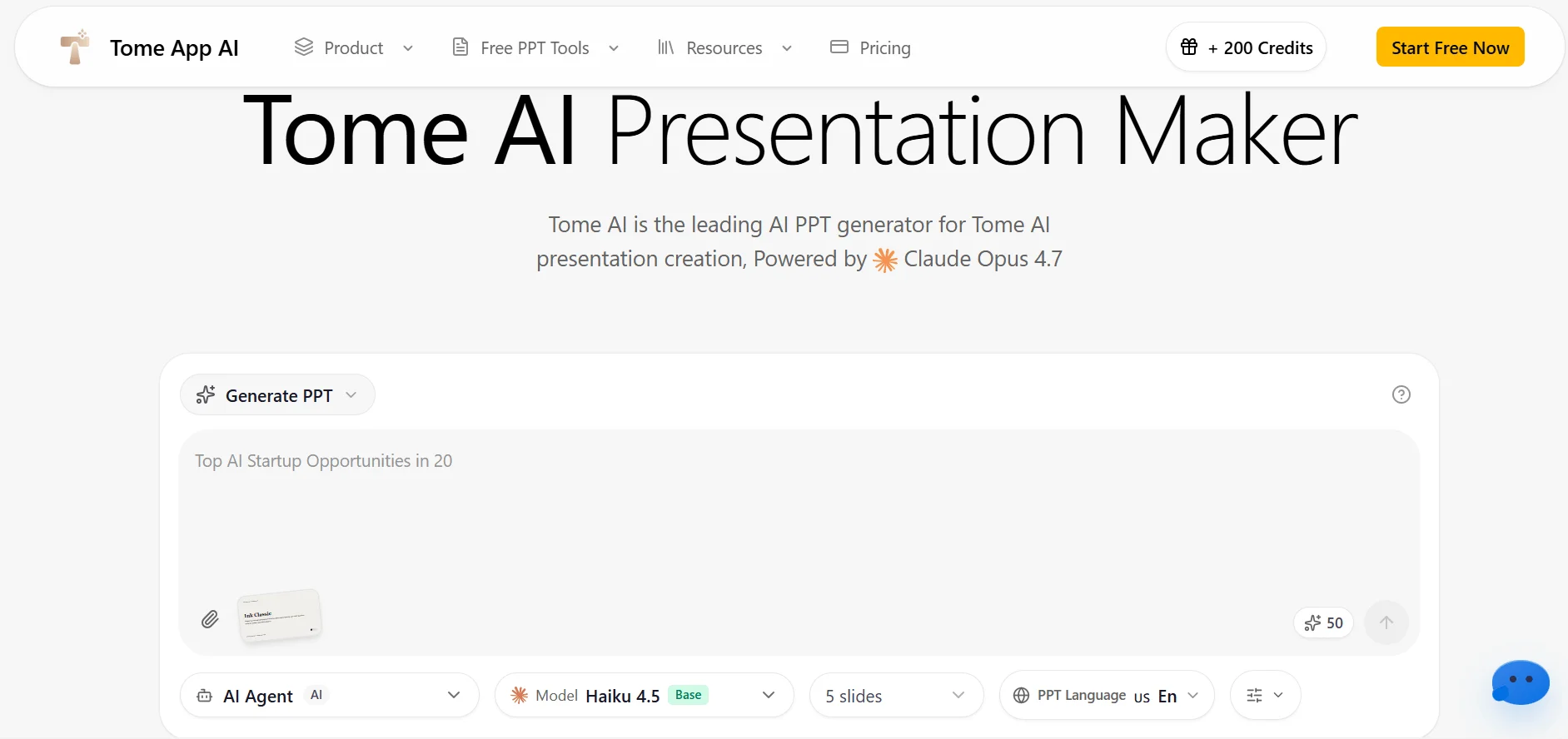
About Tome
Tome combines AI with a highly interactive canvas to help you build compelling narratives and presentations.
paymentsFreemium
language
verifiedVerified
What is Tome?
Tome combines AI with a highly interactive canvas to help you build compelling narratives and presentations.
Tome is an AI presentation tool designed for modern, highly visual storytelling. It relies heavily on integrated AI image generators (like DALL-E) to build cinematic slide decks that look more like a dark-mode website than a corporate PowerPoint.
Where it stands out: The aesthetics. Tome forces you into specific, highly curated layouts that make it virtually impossible to design an ugly presentation.
workspace_premiumAIToolsHaven Expert Review
Our Verdict on Tome
If you are raising a seed round or pitching a creative project, Tome produces the most beautiful, modern-looking presentations available.
8.8
Expert Score
Ease of Use9.2
Features8.8
Value for Money8.5
Customer Support7.9
AI Capabilities9.5
Pros & Cons
thumb_up
Pros
- check_circleIntuitive and user-friendly interfaceYou don't need a PhD in prompt engineering to get value out of this. The clean layout ensures you spend your time actually creating, not fighting with the software.
- check_circleSignificantly accelerates workflow executionTasks that used to take hours of manual clicking and formatting are now reduced to seconds, allowing you to scale your output without scaling your team.
- check_circleReliable performance with consistent output qualityUnlike some models that hallucinate wildly from prompt to prompt, this tool delivers highly stable, predictable results that you can actually rely on in a professional setting.
warning
Cons
- errorLimited functionality in the free tierThe free version is essentially just a demo. If you want to use this for serious, daily work, you will absolutely need to upgrade to a paid plan.
- errorMay require a learning curve for advanced featuresWhile the basics are easy, unlocking the true power of the platform requires spending time studying the documentation and experimenting with complex settings.
Best Use Cases
Here's a breakdown of how people are actually using this tool in the real world to speed up their workflows.
rocket_launch
Ideal for Draft Pitch Decks
Startup founders use Tome to design highly visual seed-stage pitch decks that stand out from the thousands of generic PowerPoints investors see every day.
trending_upWhy it works: Less busywork, more focus on execution.
Key Features & Capabilities
These are the core features that actually matter. Instead of overwhelming you with options, this tool focuses on doing these specific tasks exceptionally well.
done_all
AI Layouts
Stop fighting with alignment. Drop your text and images onto the slide, and the AI automatically snaps them into a visually balanced, professional composition.
done_all
DALL-E Integration
Generate unique assets mid-pitch. If you need an image that doesn't exist to illustrate a point, you can prompt the built-in image generator without leaving the presentation.
done_all
Analytics
Know what's actually working. Track exactly which slides your clients spent the most time reading, giving you critical intelligence for your follow-up calls.
Pricing & Value
The $16/month Pro tier is expensive for a presentation tool, but necessary to export to PDF and remove the Tome branding.
Pro
$16
Billed monthly
- check_circleCore features included
- check_circleStandard support
Compare Options
Compare Tome with Alternatives
Beautiful.ai is better for data-heavy, corporate slides. Gamma is better for rapid, text-to-presentation generation. Tome is best for highly visual, narrative pitch decks.
TOP RATED

star4.8
SaneBox
If you're debating between Tome and SaneBox, here is the breakdown of which one actually performs better for specific workflows.
Compare Nowcompare_arrows
star4.7
Read AI
If you're debating between Tome and Read AI, here is the breakdown of which one actually performs better for specific workflows.
Compare Nowcompare_arrowsWorkflows Using Tome
edit_note
Content Creator
Includes: ChatGPT, Canva, Opus Clip, Buffer
business_center
Agency
Includes: Notion AI, ChatGPT, Zapier Central, ClickUp
Related Collections
Real User Reviews
4.6
starstarstarstarstar
Based on 15,000 reviews
5star
75%
4star
15%
3star
5%
2star
3%
1star
2%
SJ
Sarah Jenkins
verifiedCommunity Feedback•2 weeks ago•Developer
starstarstarstarstar
I was skeptical at first, but Tome actually delivered on its core promises. The interface took a few hours to really figure out, but once it clicked, it started saving me a massive amount of time. It's not perfect, but it's easily one of the better tools in this space right now.
DC
David Chen
verifiedPublic Review•1 month ago•Marketer
starstarstarstarstar_border
I use this mostly for the heavy lifting. Tome handles about 80% of the repetitive work, and then I step in to polish the rest. Honestly, the output can occasionally be generic if you don't prompt it well, but once you learn how to steer it, it becomes indispensable.
Share & Embed
Promote Tome or embed utility cards and verification badges.