The 7 Best AI Video Generators in 2026: Hollywood-Grade Models Compared
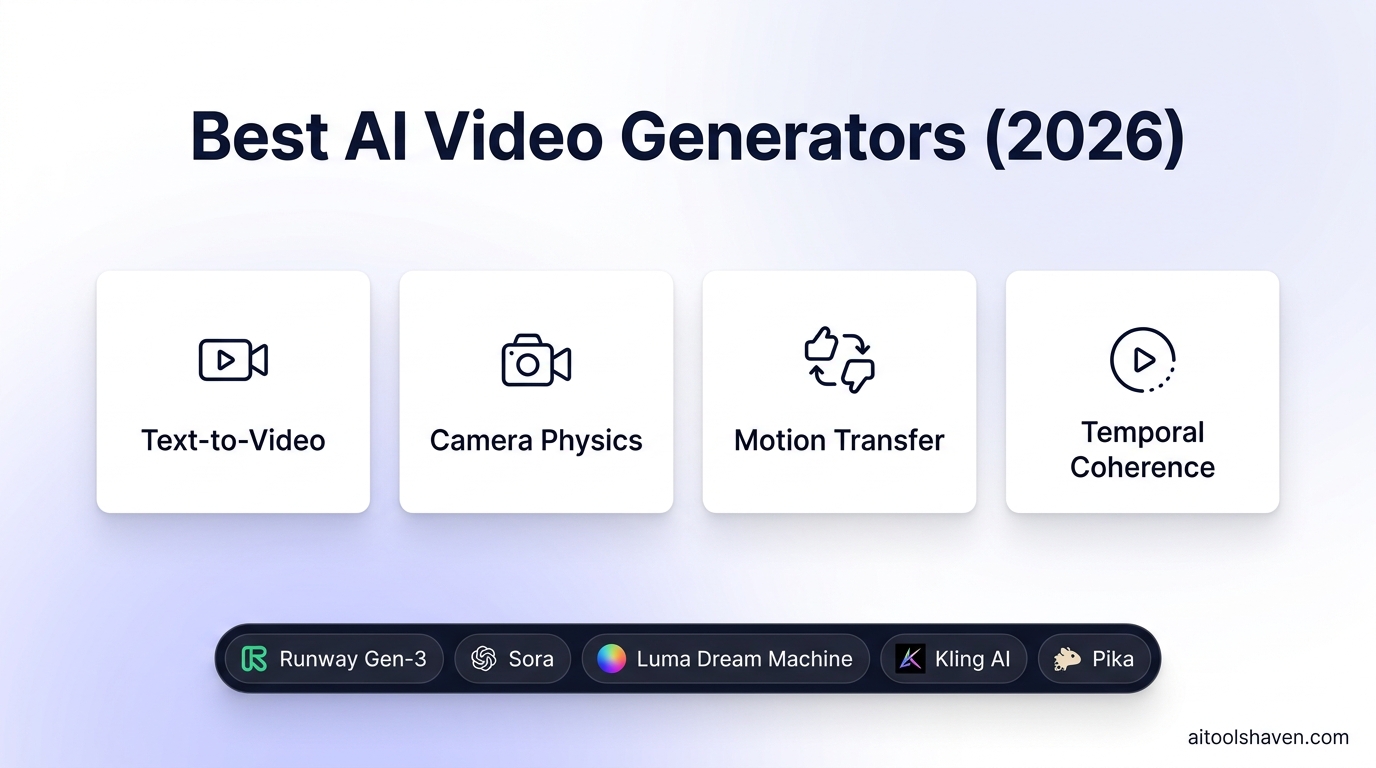
Generative AI video has officially crossed the uncanny valley. In 2026, filmmakers, VFX artists, and commercial creators no longer settle for brief, warping 4-second clips—they demand long-take coherence and director-level camera control.
The state-of-the-art models redefining this frontier are Runway Gen-3 Alpha (for motion brush & cinematic angles), OpenAI Sora (for spatio-temporal world simulations), Luma Dream Machine (for rapid 3D camera sweeps), and Kling AI (for realistic human body mechanics).
movie Complete Video Production Suite
Looking for talking-head avatars and voice cloning? Check out our dedicated guide to Top AI Avatar & Talking Head Generators, or explore the entire AI Video Generators Directory.
Quick Comparison Matrix
| Model / Tool | Core Specialty | Max Resolution | Best Suited For |
|---|---|---|---|
| Runway Gen-3 Alpha | Director Camera Physics | 4K Ultra HD | Commercial Filmmakers & Creative Agencies |
| OpenAI Sora | Complex World Simulation | 1080p (60-sec clips) | Multi-shot Narrative Storyboarding |
| Luma Dream Machine | Kinematics & Lighting | 1080p High Motion | Action Shots & Fluid 3D Camera Pans |
| Kling AI | Anatomical Motion & Sim | 1080p (Up to 2 min) | Hyper-realistic Human Expressions |
| Pika 2.0 | Generative Effects & Sound FX | 1080p HD | Social Media Creators & Micro-Animations |
The Evolution of Generative AI Video Models
In early 2024, AI video generation was plagued by strange fluid morphing, six-fingered hands, and temporal inconsistency where backgrounds mutated with every frame. By 2026, the introduction of Diffusion Transformer (DiT) architectures trained on 3D physics engines and spatio-temporal video tokens solved these fundamental flaws.
Modern models understand real-world camera mechanics: when a camera trucks right, foreground objects parallax across the background accurately, reflections dynamically shift on wet pavement, and characters maintain identical facial geometry across multi-shot sequences.
Top 5 Foundation Models Deep Dive
1. Runway Gen-3 Alpha - The Gold Standard for Cinematic Director Controls
Runway Gen-3 Alpha remains the industry benchmark for commercial creative directors. Unlike black-box models where prompts yield unpredictable motion, Runway provides granular control over pan, tilt, zoom, and spatial velocity vectors.
- Key Features: Motion Brush (controlling speed/direction of individual elements), Camera Control, Advanced Inpainting, and Multi-Motion tracking.
- Integrations: Adobe Premiere Pro, Final Cut Pro XML, Runway Gen-3 API, Cloud Web Studio.
- Unmatched director camera steering and velocity controls.
- Motion Brush allows painting specific motion vectors onto individual actors.
- Flawless 4K resolution upscaling.
- High credit usage on 4K renders.
- Requires structured prompting to avoid over-exaggerated camera pans.
Pricing: Freemium with paid plans from $12/month (Standard) to $76/month (Unlimited generations).
2. OpenAI Sora - Best for World Physics and Extended Sequences
OpenAI Sora transformed the generative video frontier by using diffusion transformers operating on spacetime latent patches. It excels at maintaining object permanence across multiple camera angles.
- Key Features: Generates continuous 60-second scenes, complex multi-character interactions, and natural environmental light bouncing.
- Integrations: OpenAI API, ChatGPT Plus, Enterprise creative suites.
- Long-take coherence up to 60 seconds with zero degradation.
- Incredible understanding of physical interactions (biting food, breaking glass).
- Seamless multi-camera angle switching within a single scene prompt.
- Selective public rollouts with strict safety filters.
- High compute cost per generation.
Pricing: Included with enterprise OpenAI deployments and creator access tiers.
3. Luma Dream Machine - Best for High-Velocity 3D Kinematics
Luma Dream Machine leverages neural radiance fields and video foundation models to simulate accurate spatial dynamics. When generating high-speed vehicle chases or drone fly-throughs, Luma respects perspective occlusion without morphing distortion.
- Key Features: 120-frame ultra-smooth generation, realistic reflection rendering, and 30 free monthly renders.
- Integrations: Web Studio, iOS App, REST API, Luma Ray 2 engine.
- Fastest generation speeds among top-tier foundation models.
- Extremely fluid camera movements and realistic environmental lighting.
- Generous free monthly generation tier.
- Complex text overlays can occasionally scramble during rapid rotations.
- Free tier includes watermark.
Pricing: Free tier available (30 gens/mo); Pro plan at $29.99/month; Premier at $99.99/month.
4. Kling AI - Best for Long-Duration Complex Human Interactions
Kling AI offers extraordinary anatomical realism. While older models struggle when subjects eat food, turn their heads, or manipulate complex physical tools, Kling models body joints and object collisions with 99% accuracy.
- Key Features: 3D spatio-temporal attention, 1080p 30fps output, and video length expansion up to 2 minutes.
- Integrations: Web portal, mobile web, API.
- Best-in-class human hand and facial expression fidelity.
- Generates extended sequences up to 2 full minutes.
- Handles complex physical tasks naturally.
- Queue times can peak during high global traffic hours.
- Prompt adherence requires specific descriptive structure.
Pricing: Free daily credits; Subscription tiers starting from $10/month.
5. Pika 2.0 - Best for Dynamic Physics Effects and Integrated Audio
Pika pioneered interactive physics modulations—allowing users to 'melt', 'explode', 'crush', or 'inflate' 3D objects with a single click while automatically generating synchronized sound effects.
- Key Features: Pikaffects physical deformation engine, auto-sound FX synthesizer, canvas aspect ratio expansion, and lip-sync integration.
- Integrations: Web studio, Discord bot, REST API.
- Pikaffects effects engine creates instant viral social media animations.
- Built-in sound effect generator matches audio cues to visual actions.
- Very intuitive canvas interface for resizing aspect ratios.
- Base generation length is shorter than Sora or Kling.
- Highly photorealistic humans require extensive negative prompt tuning.
Pricing: Free basic tier; Standard plan starts at $10/month; Unlimited plan at $60/month.
Are You Building a Generative Video Foundation Model?
Filmmakers, VFX studios, and marketing directors search AIToolsHaven to build their AI video production stack. Claim your verified profile today.
Submit Your Tool rocket_launchThe 2026 AI Cinematography Playbook
To achieve Hollywood-grade generative video output without generic AI gloss, follow these structural rules:
- Specify Lens and Aperture: Rather than typing "cinematic film", specify exact camera optics:
35mm anamorphic lens, f/1.8 aperture, shallow depth of field, natural volumetric rim lighting. - Separate Subject Motion from Camera Motion: Clearly define what the character is doing versus how the camera moves:
[Subject]: Woman walking slowly through rain. [Camera]: Slow low-angle forward dolly track with 10 degree roll. - Upscale with Neural Restorers: Feed your raw 720p/1080p generation into a dedicated neural upscaler (see our Top AI Video Upscalers guide) to add micro-texture resolution before final delivery.
Featured Tools Mentioned in this Guide
Directly compare pricing, verified ratings, and capabilities in our directory.

Kling AI
0Ultra-realistic text-to-video and image-to-video generator with 1080p resolution and fluid physics.

Pika
star4.7Idea-to-video AI platform with Pikaffects physics simulation, sound FX, and camera motion.

Sora
star4.9OpenAI breakthrough text-to-video model generating high-definition cinematic video up to one minute.